

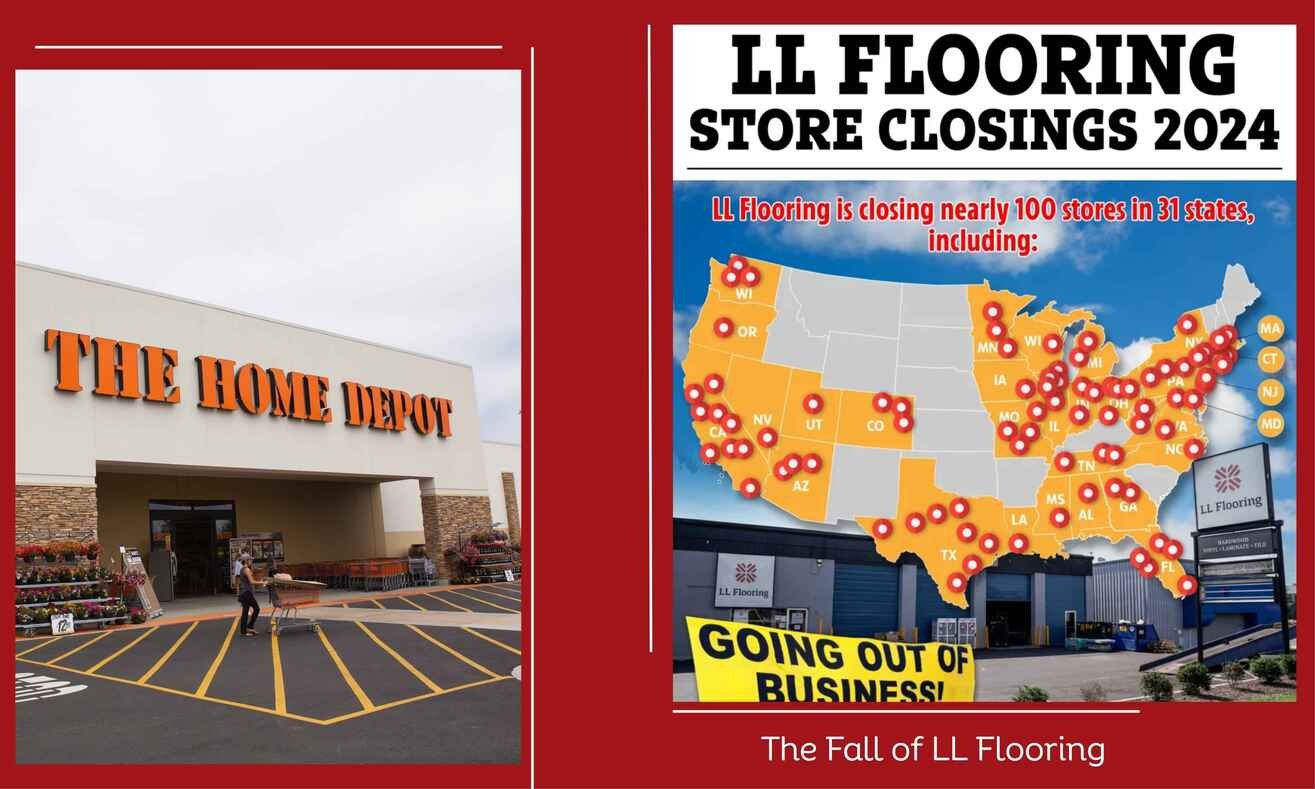
The financial difficulties and eventual closing of stores by LL Flooring has become a well-known tale in the home improvement industry. The company was once a strong specialty flooring retailer facing competition from Home Depot and Lowe’s, but it’s had trouble in recent years, as its sales have dropped, interest rates have been high, and its condition has been plagued by serious liquidity problems. In the beginning, LL Flooring has announced that it will be closing all of its stores as it was unable to find a buyer, but a last minute save plan managed to save 219 stores and keep hundreds of jobs intact, while about 211 underperforming stores were closed permanently. The closures underscore the hardships that a difficult economy and changing consumer preferences can impose on niche retailers.
What is Home Depot Rival Store Closings
When Home Depot and Lowe’s’ are hit with financial problems, the home improvement retail market can suffer a lot in terms of storefront closings. One such company is LL Flooring, a specialty flooring company that filed for Chapter 11 bankruptcy. A few initial restructuring problems resulted in the closure of around 211 substandard stores, but there was a last minute agreement to save 219 stores. The closures are indicative of the broader retail sector’s economic problems, such as high interest rates, inflation, and reduced discretionary spending on home improvements. The incident highlights the ongoing trend of large, diverse retailers such as Home Depot and Lowe’s taking over more control over the U.S. market.
LL Flooring: A Home Depot Rival
Lumber Liquidators was established by Tom Sullivan in 1994, and is now known as LL Flooring. The company had built up a reputation for selling hard wood flooring direct to their clients without the use of middlemen and hence provide a competitive price for hard wood flooring.
Over these years, it started to become rapidly established throughout the U.S. and was among the leading specialty flooring companies in the country. The company has also recently been re-branded as ‘LL Flooring’ in 2020 due to a line of controversial brands. It was a highly successful company, prior to bankruptcy, with more than 430 stores in dozens of states and matched Home Depot and Lowe’s in terms of flooring products.
Why did LL Flooring file for bankruptcy?
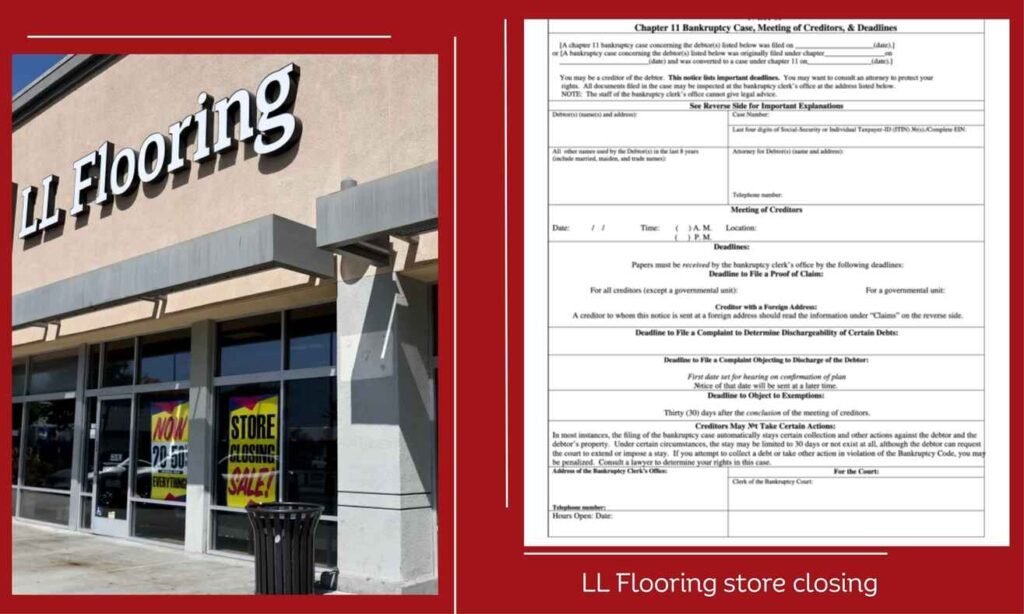
On August 11, 2024, LL Flooring sought chapter 11 bankruptcy protection in the U.S. Bankruptcy Court for the District of Delaware. The company originally was trying to restructure, but not to the extent of doing away with a portion of the business. Management wanted to close down unprofitable stores, cut costs and a buyer who would hold the brand going.
But, even though talks were held with several interested parties, none of them made it to a successful sale. This meant that the company had to move from restructuring to a complete liquidation of the retail side of its businesses.
Timeline of LL Flooring’s Store Closures
August 2024: Bankruptcy Filing
- Filed for Chapter 11 bankruptcy protection.
- Obtained secured financing for “debtor in possession” to preserve some business operations.
- Declared that it would shut 94 underperforming stores.
Search for Buyers in August/September 2024
LL Flooring carried on talks with interested parties during the bankruptcy process, and attempted to sell the business as a going concern. Management said it had done all it could to preserve the company and maximise for the benefit of creditors.
Full Liquidation commences in September 2024
The company initially announced a full wind down when the bids were not obtained, but on 6th September 2024, the company was able to obtain a last minute rescue deal. Private equity firm F9 Investments came to the rescue to acquire 219 stores in operation and the brand’s intellectual property. As a result, the total liquidation was avoided, with about 50% of the store network staying open and 211 stores with poor performance having to go through store-closing clearance sales.
How many of the LL flooring stores were closed?
A total of 211 stores (out of the 430+ stores in the Company) were found to be underperforming which were permanently closed and liquidated. The rest of the 219 storefronts were spared thanks to the acquisition and continue to serve under new corporate sponsorship.
How many workers was lost their Job
Although the eleventh hour deal saved about 800 jobs at the 219 remaining stores, over 1,100 employees were laid off between the 211 liquidating stores, headquarters and distribution center. Under the terms of the last minute agreement, F9 Investments, a private equity firm.
Official Statement by LL Flooring Management
The bankruptcy was the result of a “long process” of trying to stem financial losses brought on by the tough economic conditions, CEO Charles Tyson said.
Tyson announced that it would begin to “unwind” after posting weak sales numbers. Tyson said that liquidating was “disappointing but necessary” as part of the Chapter 11 bankruptcy proceedings. The company’s management officially declared the affairs cannot be reorganized.
What happened to the consumers?
There were a number of changes that customers went through during the liquidation of LL Flooring. A series of store sales, holding clearance days to manage the stock, and a progressive lack of availability of some products was the company’s response. We did not receive any orders to install any new floors. Some projects were completed if they were able to be finished. Refunds/Customer Claims were processed as per the bankruptcy court instructions. This included an arbitrary cut off date that all customer gift cards became expired and worthless on September 3, 2024. Following the close of the individual stores’ liquidation sales, the remaining 219 “rescued” stores returned to normal business operations in their new corporate format, and the 211 stores that didn’t make the cut were shut down after all.
Flooring now for sale in customers shops
Other flooring retailers are now customers’ choice, including:
- Home Depot
- Lowe’s
- Local flooring dealers
- Independent flooring specialists
- Online flooring retailers
To buy, consumers should do the research and compare:
- Product quality
- Warranty coverage
- Installation services
- Pricing
- Customer reviews
Impact the Home Improvement Industry
The company’s closes bolster the market share of big home goods stores.
Among the major retailers who benefit from is Home Depot and Lowe’s.
- Greater financial stability
- Wider product selections
- Stronger supply chains
- Multi-channel customer experiences, improved
- Larger larger networks of professional contractors
But specialty retailers are still threatened by a drop in consumer spending and rising costs. The closures also highlight how quickly the liquidity situation can spiral out of control if retailers have a high percentage of discretionary home improvement activity.
What Impact does this have on the Retail Sector?
The bankruptcy is another indication of U.S. retail’s troubles. Still yet to impact the home improvement industry are higher interest rates, slowing home business, inflation and consumer spending trends. Larger and more diversified national distributors are more likely to be able to meet these challenges, while smaller, specialty retailers will be at risk financially. However, with the partial closing of LL Flooring, consumers now have fewer dedicated specialty options, allowing dominant players like Home Depot and Lowe’s to consolidate more power and capture displaced market share.
What Shoppers should know in the future
While consumer shopping, they need to bear these things in mind:
- Over 200 saved retail locations remain fully open and operational, having reverted back to their original Lumber Liquidators brand name.
- All questions concerning the warranties or from a bankruptcy must be dealt with in accordance with the court rules.
- Shop around for the best price.
- Carefully read the installation services and warranties.
- Watch out for sales at other home improvement retailers.
Conclusion
LL Flooring’s bankruptcy and closing up shops across the country is one of the biggest news stories to come out of the home improvement retail field in recent times. The company, which once was among the top flooring specialists, but had been in competition with Home Depot and Lowe’s, was unable to hold on to the ongoing liquidity issues, supplier issues, low sales, high interest rates and lack of interest in renovations.
The 211 stores that were permanently closed and the hundreds of jobs impacted were the only result that isn’t entirely good one, but fortunately the last-minute effort to save 219 stores means that consumers will still have some local specialty shopping options. In the meantime, it highlighted the growth of large, home improvement retailers with bulkier product lines, stronger business models and financial performance. Ultimately, LL Flooring’s implosion serves as a cautionary tale of how quickly reputational damage, heavy debt, and shifting macroeconomic climates can bring down a prominent specialty retail giant.
FAQs
No. While 211 underperforming locations were liquidated and closed, a rescue deal saved 219 stores, keeping them fully operational.
Yes. Although the eleventh-hour rescue agreement saved approximately 750-1,000 jobs, over 1,000 employees eventually lost their jobs due to permanent shutdown of the 211 unprofitable stores, warehouse consolidation and elimination of corporate employees.
Product warranties and return rights are being administered in accordance with the bankruptcy court. If you have an existing claim you will need to file a claim with the court appointed claims agent.
No. As part of the rescue deal, private equity firm F9 Investments began the process of changing the 219 stores names back to Lumber Liquidators.
Also Read: Vivo Y400 Pro: Features, Specifications, Price, Camera, Battery & Full Detailed Review

