

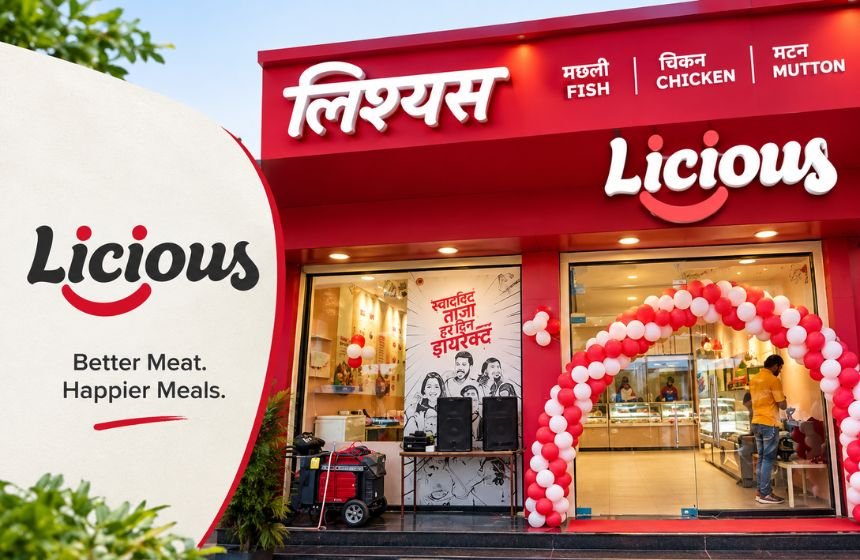
Licious is a direct-to-consumer (D2C) and food-tech startup specializing in fresh meat, seafood, and ready-to-cook food based in India. The team conceived the concept to facilitate Indian customers with the ease, health, and orderliness of their meat and seafood purchases. Licious began in 2015 and slowly grew from Bengaluru to other cities of India. The company went beyond being an online marketplace and built a technology-rich supply chain that goes from sourcing to processing, quality control, packaging, cold storage, and delivery. This article will provide complete information about Licious Company.
Licious: Company Overview
The company’s founders, Abhay Hanjura and Vivek Gupta, spotted a gap in India’s mostly unorganized and fragmented meat market. As the years went by, Licious grew and diversified its offerings. It also heavily invested in cold chain infrastructure, technology, food safety, and delivery operations. The company said it had served over one million customers and was part of over 15 million meals by 2021.
| Category | Details |
| Company | Licious |
| Founded | 2015 |
| Founders | Abhay Hanjura and Vivek Gupta |
| Industry | Food-Tech, D2C, Meat and Seafood |
| Business Model | Direct-to-Consumer |
| Main Products | Fresh meat, seafood, and ready-to-cook products |
| Key Focus | Freshness, quality, hygiene and convenience |
| Technology | E-commerce, data, logistics and supply-chain technology |
| Delivery Model | Cold-chain delivery |
| Headquarters | Bengaluru, India |
How Licious Started and Expanded
Licious was established in 2015 by Abhay Hanjura and Vivek Gupta. The founders realised a need to create a solution for consumers to buy meat and seafood in India. This was the case when customers were provided with little information about the source of meat, processing methods, storage, and hygienic handling of meat. Licious tried to tackle these issues by establishing a more streamlined supply chain.
The company began operations in Bengaluru and then branched out to many other major cities in India. Some of the initial markets to expand were Delhi-NCR, Mumbai, Pune, Chandigarh, Mohali, Panchkula, Hyderabad, and Chennai. Licious was able to take more control of its supply chain than a traditional online market would. This meant control over sourcing, processing, cutting, packaging, storage, and delivery.
This integrated system was one of the key features of the company.
Who Founded Licious?
The founding of Licious was founded in 2015 by Abhay Hanjura and Vivek Gupta. The founders wanted to develop a brand that consumers would trust for fresh meat and seafood in India. They weren’t just looking to sell meat via an app or website.
But they wanted to enhance the overall customer experience. They targeted several steps of the process, which involve sourcing, processing, packaging, and delivery. The founders combined technology with food processing and supply-chain management to create a D2C meat business.
What Does Licious Sell?
| Product Type | Popular Products | Approx. Price Range |
| Chicken | Curry Cut, Breast, Drumsticks, Thighs | ₹150–₹400 |
| Mutton | Curry Cut, Keema, Boneless Mutton | ₹350–₹800 |
| Fish | Rohu, Pomfret, Basa, Salmon | ₹200–₹900 |
| Prawns | Whole Prawns, Tail-on Prawns | ₹250–₹700 |
| Ready-to-Cook | Kebabs, Marinated Chicken, Burger Patties | ₹150–₹500 |
| Cold Cuts | Chicken Salami, Sausages, Ham-style products | ₹200–₹500 |
How the Licious Supply Chain Works
Licious has a vertically integrated D2C business model. The Licious Business Model Works Step-wise
Sourcing
Licious invests in quality and freshness and select their suppliers and farms for meat and seafood.
Primary Processing:
Sourced meats undergo central cleaning, standardized cutting, and safety checks under strict temperature controls
Quality Checks
The product will undergo quality and safety testing prior to the next step.
Packaging
We use special packaging to package the products that will ensure their freshness during transportation.
Cold Storage
Operating under a strict ‘never frozen’ cold chain policy, all fresh products are constantly maintained between 0°C and 4°C from the farm to the customer’s doorstep to retain quality.
Online Ordering
Users visit the Licious website or app, choose their desired products, and make a purchase.
Order Fulfillment
Once an online order is received, micro-fulfillment centers handle any customized finishing cuts or specific portion packaging requested by the customer before dispatch.
Cold-Chain Transportation
Orders are transported through temperature-controlled logistics to help maintain product quality.
Home Delivery
The order is mailed straight to the consumer’s preferred address.
Customer service & Data
Licious gathers customer feedback and applies business information to enhance product selection, stock management, delivery, and customer experience.
Also Read: Nykaa Fashion: Inside Its Brands, Products, Prices, Competitors and Business Model
Technology Supporting the Business
Even though Licious is in the food business, technology plays a big part in their business. Consumers can access products online, choose amounts and cuts, and order and receive products online.
The technology can help support the customer-facing platform:
- Demand forecasting
- Inventory management
- Supply-chain planning
- Order management
- Delivery optimization
- Customer analytics
- Product recommendations
- Warehouse management
- Customer service
Data can be used to gain insight into which products are popular, when demand for a product is increasing, and when certain products are often bought together.
Technology is thus an important component of the customer experience and the company’s operations.
How Orders Reach Customers
Licious delivers meat, seafood, eggs, and ready-to-cook meals using multiple channels. These include its website, mobile app, physical stores, and third-party quick-commerce platforms. Customers can place orders through the Licious platform. Delivery options vary depending on where the customer lives. The company uses a temperature-controlled chain throughout processing, storage, and transportation.
This helps keep products fresh and maintain quality. In some areas, Licious offers delivery for customers who need it. Products are also available on quick-commerce platforms like Swiggy Instamart and Blinkit. These partnerships allow customers to buy selected items quickly. Delivery times, product availability, and service options depend on the customer’s location and the local fulfillment capacity. What works in one city may not be available in another.
From Online Platform to Physical Stores
While founded as a purely online platform, Licious transitioned into an omnichannel business model by establishing physical experience centers. Expanding aggressively into offline retail, the brand has scaled to over 60 physical outlets across Bengaluru and Mumbai, a retail footprint driven by organic expansion in Mumbai and accelerated in Bengaluru by its acquisition of local retail chain My Chicken and More. By adding stores, Licious becomes an omnichannel business model.
Customers can engage with the brand via:
- Online ordering
- Mobile and digital platforms
- Home delivery
- Physical stores
This is because the company will have several ways to engage consumers.
How the Direct-to-Consumer Model Works
This direct-to-consumer approach enables Licious to cut out intermediaries and have more control over the customer experience.
The company’s D2C process may entail:
- Product sourcing
- Processing
- Quality control
- Packaging
- Online ordering
- Cold storage
- Delivery
- Customer service
The model also enables the company to access information of customers and purchases. For instance data can be used to analyze popular products, understanding the seasonal demand, analyzing the preferences of customers, and frequently bought products. This data can be valuable to inventory planning and product development.
From Startup to Unicorn and IPO Plans
Licious started as a startup in Bengaluru. Over time, it grew into a fledged business that sells meat and seafood through online delivery, retail stores, and fast fulfillment centers. In the year 2025, Licious made ₹795 crore in revenue. The year in 2026 that number went up to ₹1,166 crore. That’s a 47% increase compared to the previous year. (Source verified via Economic Times)
The company expanded its network of stores and delivery services. It focused on bringing in repeat customers and improving coverage in cities. Licious reached unicorn status in 2021 when its value hit $1.5 billion during a funding round in 2023. The company is now preparing to go public with an IPO. Reports from 2026 have given different timelines for the listing. So as of September 2026, the exact date for the IPO has not been confirmed.
Why Licious Became Popular
Licious has seen its growth due to several reasons.
Convenience
Meat and seafood products can be ordered from home without having to go to the traditional meat market.
Product Variety
Licious has various cuts, portions, marinades, and ready-to-cook products.
Standardized Packaging
Branded packaging establishes a uniform shopping experience and safeguards the products during transportation.
Hygiene
The company focuses on controlled processing, quality control, and food-safety measures.
Cold Chain
Temperature-controlled storage and transportation are important for handling perishable products.
Technology
Digital ordering simplifies the way customers find products, choose the quantities, and make the order.
Brand Focus and Customer Proposition
Licious has been established on the motto of freshness, quality, hygiene, and convenience. The company has established itself as a contemporary alternative to the conventional system of sourcing meat.
It has been marketing to provide greater confidence to consumers in the products they buy. The firm also notes that its meat products aren’t frozen, but rather fresh, and points out the care taken in its supply chain management. This branding move has helped Licious to establish a brand name in the organised meat market of India.
Sustainability and Responsible Sourcing
Sustainability and responsible sourcing are also a part of Licious’ declared business priorities.
The firm has talked about efforts on:
- Responsible sourcing
- Animal welfare
- Waste management
- Food safety
- Social responsibility
- ESG practices
In addition, Licious has referred to food safety and social responsibility certifications and standards. Sustainability can impact several aspects of the company’s business operations, as it is involved in sourcing, processing, packaging, and logistics.
Licious: The Unicorn Milestone
- Licious has emerged as one of the key players in the food-tech sector in India and is in the unicorn club.
- The milestone marked the increasing investor interest in the Indian online food, grocery, and consumer-tech markets.
- The growth of the company also showed the potential to create a brand-based business around fresh meat and seafood.
- However, this class poses many operational issues. The meat and seafood value chain is unlike many areas of e-commerce in that it has a short shelf life and needs special facilities.
- Businesses in this field need to keep track of such things as cold storage, inventory, demand forecasting, processing, packaging, and last-mile delivery.
Business and Operational Challenges
The Licious company is in an extremely challenging business environment.
High Operating Costs
Large investments are needed for cold storage, processing, packaging and delivery facilities.
Perishable Inventory
The shelf life of meat and seafood products is limited. Inadequate demand forecasting can lead to wastage and loss of money.
Competition
While there is a lot of competition from wet markets and supermarkets, Licious has carefully worked with fast delivery companies, like Blinkit, Swiggy Instamart and Zepto, to reach customers quickly. This way, what could have been rivals are now helping deliver products to people.
Price Sensitivity
Indian consumers are familiar with the local retailers of meat products. Branded businesses of meat products must prove enough value in their convenience, quality and service.
Supply Chain Complexity
Quality control is a challenge as a company grows city by city. The business needs to arrange for the sourcing, processing, inventory and packaging, and store and distribute the product at suitable temperatures.
Potential Areas for Future Expansion
There are multiple aspects that could affect Licious’s growth in the future. They range from market expansion, ready-to-cook products, offline retail, technology enhancements and supply-chain efficiency. The ready-to-cook market is available for expansion beyond raw meat and into the broader convenience-food market. Also, technology can be leveraged to enhance demand forecasting, inventory management, personalization and delivery efficiency. Therefore, cost management and product quality will be vital to the company’s expansion efforts.
How to Place an Order
The Licious order is designed to be simple to place online.
Step 1: Log in on the Licious Platform
Go to the official Licious Website or open the Android/iOS app
Step 2: Select your location
Type your delivery address or pick your city to see products in your area.
Step 3: Browse Products
You can try different poultry, mutton, fish, seafood, eggs, ready-to-cook and other food items in the categories.
Step 4: Choose the product
Choose the product you want to purchase. Ensure there’s an adequate supply, length, weight and other product specifications.
Step 5: Place Products into Cart
Click on the number of products needed and they will be added to the shopping cart.
Step 6: Check your Order
Review your chosen products, quantities, delivery address and total order amount before ordering.
Step 7: Choose a Delivery Slot
Select an available delivery option or time slot based on your location.
Step 8: Make the Payment
Choose an available payment method and complete the payment process.
Step 9: Track Your Order
After placing the order, you can track its status through the Licious platform.
Step 10: Receive Your Order
The products are delivered to your selected address using the company’s delivery network and temperature-controlled processes.
Conclusion
Licious has played an important role in bringing the D2C model to India’s fresh meat and seafood industry. Founded in 2015 by Abhay Hanjura and Vivek Gupta, the company built its business around fresh meat, seafood, technology, cold-chain logistics, quality control and convenient delivery.
Its approach goes beyond simply selling meat online. Licious has attempted to manage several stages of the process, including sourcing, processing, packaging, storage and delivery.
Its product portfolio has expanded from fresh chicken, mutton and seafood to ready-to-cook products. The company has also invested in technology, food safety, packaging, warehouses and delivery infrastructure.
The Licious business model shows how technology and organized supply-chain operations can be applied to traditional food categories. Its future growth will depend on how effectively it manages operational costs, competition, freshness, consumer expectations and expansion while maintaining the quality and convenience associated with its brand.
FAQs
Licious is an Indian D2C food-tech company that sells fresh meat, seafood, and ready-to-cook products.
Licious was founded in 2015 by Abhay Hanjura and Vivek Gupta.
Licious offers chicken, mutton, fish, seafood, eggs, kebabs, marinades, and various ready-to-cook products.
Licious uses a controlled cold-chain system covering processing, storage, transportation and delivery.
You can order through the Licious website or mobile app by selecting your location, choosing products, adding them to your cart and completing the payment.
Also Read: Blue Dart: Services, Tracking, Charges, Delivery Time, History and More

 and food-tech startup specializing in fresh meat, seafood, and ready-to-cook food based in India.)
[…] Licious: Founders, History, Business Model, Products, Growth and IPO […]
[…] Licious: Founders, History, Business Model, Products, Growth and IPO […]