

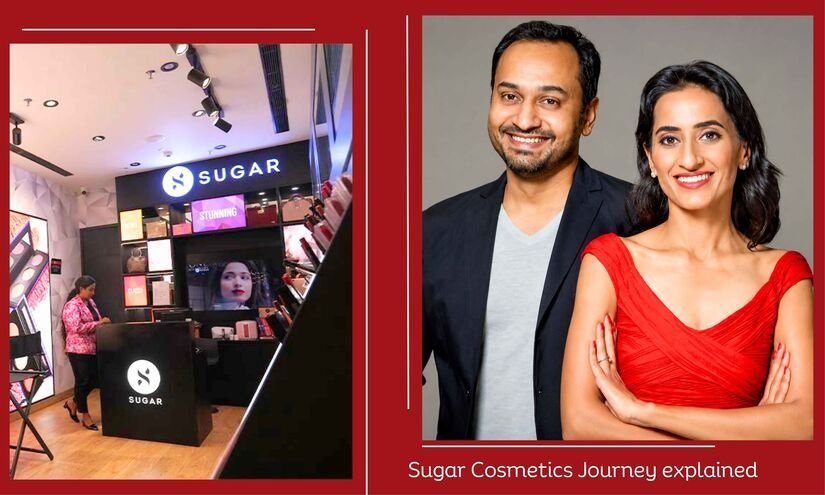
SUGAR Cosmetics is an Indian beauty and cosmetic brand selling colour cosmetics online and offline through its omnichannel distribution network. Sugar Cosmetics Founder Vineeta Singh and Kaushik Mukherjee launch the brand in 2015, SUGAR started off as Sugar Beauty producing “cult-favourite” products characterized by ultra-high pigment and longevity, developed specifically for Indian skin tones and the country’s hot and humid climate.
The brand’s trajectory from online-first Direct-To-Consumer (D2C) startup to 45,000 retail touchpoints is one that has disrupted the cosmetics industry in terms of what it means to market beauty in the modern era. Now experiencing hyper growth in the Indian marketplace, SUGAR is scaling back operations to focus on unit economics stabilization and brick-and-mortar store profitability in pursuit of larger corporate fiscal health. Vineeta Singh launched SUGAR Cosmetics to connect with her audience through makeup.
SUGAR Cosmetics: Overview
Founded in 2015, SUGAR Cosmetics competes in the Indian Beauty and Personal Care (BPC) industry. Operating under Vellvette Lifestyle Private Limited, SUGAR offers consumers an extensive assortment of products within the color cosmetics category ranging from lip products and foundation to eyeliner, primers and more recently, custom-made skin care.
| Particular | Details |
| Company Name | SUGAR Cosmetics |
| Legal Entity | Vellvette Lifestyle Private Limited |
| Founded | 2015 |
| Sugar Cosmetics Founder | Vineeta Singh & Kaushik Mukherjee |
| Headquarters | Mumbai, Maharashtra, India |
| Industry | Beauty & Personal Care |
| Business Model | Omnichannel (D2C + Offline Retail) |
| Product Categories | Lips, Eyes, Face, Nails & Skincare |
| Retail Presence | 200+ Exclusive Brand Outlets |
| Retail Network | 45,000+ Retail Touchpoints |
| International Presence | Middle East |
Sugar Cosmetics Valuation
According to estimates, as of 2026, SUGAR Cosmetics will be worth ₹1,400–1,500 crore (about $165–175 million). It was much lower than its peak valuation of about ₹3,000 crore (about $500 million) in 2022, when the company was raising additional capital after intense retail consolidation and as its revenue figures slow down due to a greater emphasis on profiting from its businesses.
The Motivation to Start SUGAR Cosmetics
The brand’s main driver was the recognition of an obvious gap in the consumer market by the founders. In an earlier business when they launched FabBag (a monthly subscription box for beauty products), they studied the feedback in detail from thousands of Indian cosmetic consumers.
They decided that international luxury brands were too costly to be used for everyday use at the office or college, and that domestic brands were not created in bold shades as they were feeling the need for something more modern and luxurious. Moreover, the formulations were developed for cooler climates in the West and lighter skin tones, which resulted in them smudging, melting or leaving behind an artificial ash-like layer on a variety of Indian skin tones.
How SUGAR Cosmetics Started: The Complete Journey
In 2015, SUGAR Cosmetics officially went online, as a Direct-to-Consumer (D2C) digital-first brand. With a small internal team, less than 10 people and a small office in Mumbai, they launched only two product lines – black eyeliner and matte eyeliner pen.
They had a sales run rate of ₹10 crore by 2017 and had opened their first physical mall retail kiosk. They quickly grew to become multi-brand department store chains on a national scale, from 2019 to 2024. But by 2025 and 2026, the market saturation trend drove companies to focus on footprint rationalization and cost reduction.
Sugar Cosmetics Investors
The startup was a bootstrapped company, with founders’ money and the balance from their subscription box business. They shifted to a corporate structure with funding from venture capital and went so far as to raise a Series D round to alleviate cash flow constraints for large-scale manufacturing and physical stores.
About $96.3 million has been successfully raised through 16 rounds of capital raising. Some of the leading I-VC companies including L Catterton, A91 Partners, Elevation Capital, India Quotient, Anicut Capital and Stride Ventures are among those who are handling the company’s ongoing working capital needs.
| Key Investors | Funding Round | Impact / Operational Focus |
| India Quotient | Early Seed | Successfully piloted the early D2C playbook |
| A91 Partners, Elevation Capital | Series B & C | Invested heavily in the offline retail channel |
| L Catterton | Series D | Faster supply chain, R&D and brand equity |
| Anicut Capital, Stride Ventures | Bridge & Debt | Working capital financing through the infusion of capital |
SUGAR Cosmetics Struggles and Challenges
Establishing the brand entailed high operating challenges in product manufacturing and logistics. At the beginning, the specialized machines to produce matte lipsticks with high pigment were not available in indian contract manufacturing plants. To overcome this, SUGAR’s early formulas were outsourced to German and Italian laboratories.
In addition, they had small budgets for advertising and could not afford to advertise on TV or billboards. This left the lean startup without any other option but to use social media channels to educate consumers and change their minds about buying cosmetics at first sight without trying them themselves.
How to be 70% successful with SUGAR Cosmetics?
The biggest success for the company was its Matte As Hell Crayon Lipstick collection which was an instant hit and viral favourite for its intensive formula and long-lasting effect. Instead of the simple black cosmetic tubes that are common on the retail shelf, they switched to colorful, custom-designed, geometric low-poly graphic art boxes which stand out among the many similar boxes on the shelf.
This enabled online shoppers to test shades in-store for the first time, thus closing the trust gap between online and physical department stores. Last but not least, Vineeta Singh’s appearance in Shark Tank India as an investor gave a tremendous organic brand visibility to the household business.
SUGAR Cosmetics Business Model
SUGAR Cosmetics is a digital-first omnichannel business that sells its products across the official website, mobile app, and top e-commerce platforms such as Nykaa, Myntra and Amazon. The brand also has a solid offline presence through 200+ Exclusive Brand Outlets (EBOs) and 45,000+ retail touch points. It’s estimated that 60-65% of its income is offline retail and 35-40% online. The company has also expanded with other product lines to meet different customer demands, such as SUGAR POP, its affordable beauty line and Quench Botanics, its targeted skin care program.
Business Model Overview
| Channel | Details | Revenue Share |
| Offline | 200+ EBOs & 45,000+ retail touchpoints | 60–65% |
| Online | Official website, App, Nykaa, Myntra & Amazon. | 35–40% |
Brand Portfolio
| Sub-Brand | Focus |
| Quench Botanics | Specialised skincare |
| SUGAR POP | Affordable beauty products |
SUGAR Cosmetics Valuation & Revenue
In fact, the company has embraced influencer marketing as a key component of their marketing strategy, with a focus on alternative celebrity dynamic formats. They seeded products to thousands of micro- and nano-creators, which allowed them to get a regular flow of authentic video tutorials, shade-swatch reels, and transformations of makeup across Instagram and YouTube.
They create digital content that caters to very localized events, from Indian festivals to monsoon-proof lookbooks and wedding routines. The educational nature of this approach, along with the value added to their personal brands through their founders, leads to reduced customer acquisition costs and enhanced retention via multi-tier app loyalty rewards.
The financial cycles of the past few years reveal structural pressure, with high expansion overhead surpassing product demand and leading to a strategic turnaround.
| Financial Metric | FY2023-24 (Audited) | FY2024-25 (Unaudited) | FY2025-26 (Projected/Current) |
| Annual Revenue | ₹505 Crore | ₹415 Crore (Down 17.8%) | ₹380 Crore |
| Net Profit / Loss | ₹68 Crore Loss (Audited) | ₹134 Crore Loss (Widened) | Working to cut down on cash burn. |
| Peak Valuation | ₹3,000 Crore (2022) | ₹2,943 Crore (Jan 2025) | ₹1,400 – ₹1,500 Crore (Down Round) |
| EBITDA Margin | -11.5% | -26.0% | Target: -6.7% |
Low rental margins at the physical outlets, high costs for online ads and market discounting cut into operational margins. This resulted in a proposed bridge rescue round of ₹100-150 crore at a 50% estimated haircut, which will optimize the unit economics and cash flow within the company.
Key Achievements and Key Milestones
However, SUGAR Cosmetics has overcome significant business restructuring and attained significant distribution successes since inception. It successfully created a retail footprint of 45 k across tier-1, tier-2 and tier-3 India.
The successful launch of its mass-market sub-brand SUGAR POP enabled it to attract younger consumer segments, accounting for about 24% of group revenue. Moreover, the brand set up a global supply chain, ensuring that its products were manufactured in specialised facilities in Germany, Italy, India, USA and South Korea, all of which met international quality standards.
Yes, but the world of business is about unit economics, not about burning cash in a way that is financed by a VC. The minimum cost of D2C capsule launch with three to five signature shades is estimated to be ₹15 lakhs to ₹30 lakhs.
For a mid-scale omnichannel model, the initial manufacturing minimum, designing the packaging and laboratory safety compliance require ₹1 crore to ₹3 crores. Rather than having their own factories, the entrepreneurs can use third party contract manufacturers such as Fiabila or Vedic Cosmeceuticals to develop customised white labelled formulations.
| Category | Details |
| Capital | ₹15L–₹30L (Capsule) |
| Formulations | Third-Party Labs |
| Branding | Instagrammable Art |
| Marketing | Organic Micro-Reels |
The most significant challenge is the offline retail cash trap, in which the margin demands of the distributors are 35-40%, and the credit cycle is 90-120 days, which can cause the working capital to be rapidly exhausted. New markets are emerging niche markets like clear beauty for vegans, sweat-proof sports gear, or even cosmetics formulated for darker skin tones.
Conclusion
SUGAR Cosmetics is a prime example of how a local startup can match and even out-compete the big boys of the beauty industry by knowing their consumers’ needs and preferences. The increase is a testament to the power of unique packaging, community education and omnichannel distribution.
Meanwhile, it just went through valuation adjustments and its widening net losses are an obvious cautionary tale that too much growth can erode financial stability if not underpinned by solid unit economics. Despite its appeal, the Indian market is not only an attractive prospect for modern beauty companies, but over the long term it is important to focus on sustainable margins and solid operational bases rather than the hype of the digital moment.
FAQs
Vellvette Lifestyle Private Limited is the parent owner. The co-founders still own 25.76% of the company, with majority shareholders being institutional venture capital firms, such as L Catterton and A91 Partners
Vineeta Singh, the co-founder, is the Chief Executive Officer (CEO) in charge of public relations (PR) and marketing. Her husband Kaushik Mukherjee is the Chief Operating Officer (COO) of the company, responsible for technology and logistics.
The brand has valued itself between ₹1,400 Crore and ₹1,500 Crore ($165 Million to $180 Million) from the ₹3,000 Crore valuation it achieved in 2022 after a series of restructuring in the retail segment.
No, not now it is not profitable. The company has seen its annual net loss slip to Rs 134 crore for FY2024-25 as its revenue growth has been fast while its storefront expenses have been high and digital competition is strong.
Their official app, Amazon, Nykaa, and Myntra also sell products online and so do several quick-commerce apps such as Blinkit. They are also available offline in 200+ exclusive and department counters.
Also Read: Home Depot Rival Store Closures Explained: The Fall of LL Flooring

. Founded in 2015, Operating under Vellvette Lifestyle Pvt. Ltd.)